What you can cut from a quote: the AP rule, the Times rule, and where AI transcripts fit
You have the transcript open and a sentence you want to use. The speaker said it like this:
Well, I mean, we… we knew about the numbers, uh, in like March, I think? And we didn’t, we didn’t do nothing about it.
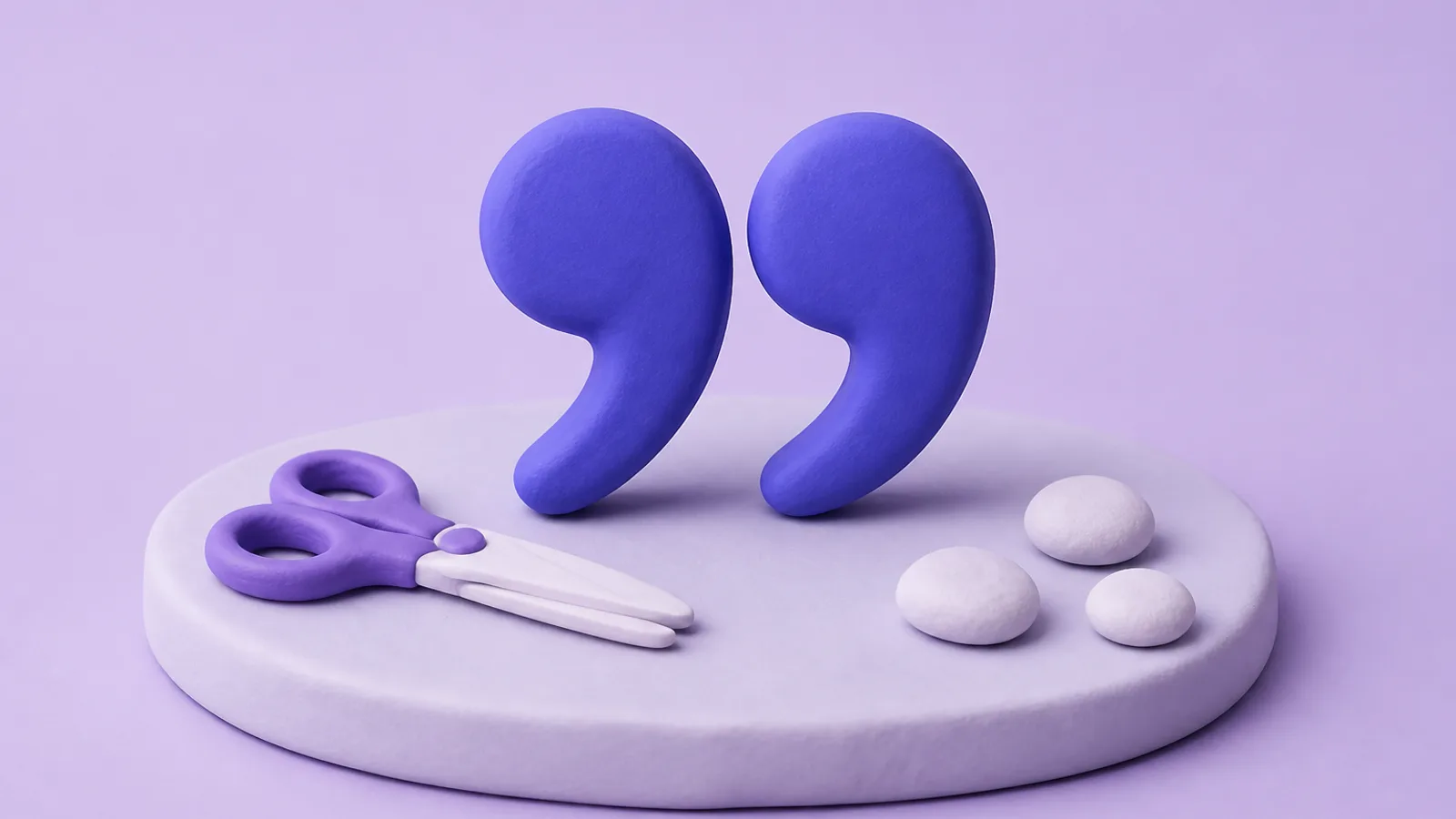
You are about to put quotation marks around part of that. Quotation marks are a promise: these are the person’s words, in the order they said them. So which of those words are you allowed to remove before you make the promise?
Style guides answer this, and they mostly agree - just not about the part everyone assumes.
What the three big rulebooks say
The wording below comes from the AP, New York Times and Washington Post style guidance as quoted by Slate in 2010. Stylebooks are revised, so treat these as the settled principle rather than today’s exact page - AP has changed other quotation guidance since, as you will see below.
AP: “Never alter quotations even to correct minor grammatical errors or word usage.”
The New York Times: “The Times does not ‘clean up’ quotations.”
The Washington Post: “when we put a source’s words inside quotation marks, those exact words should have been uttered in precisely that form.”
Read literally, all three forbid touching anything. In practice all three permit removing hesitation sounds - the ums and uhs - and the Times goes further, allowing reporters to “judiciously delete false starts” without marking the cut with an ellipsis.
That is a bigger concession than it looks. “We… we knew” becoming “We knew” is a silent edit that no reader can detect, made under a policy whose headline sentence says no cleaning up. The rule is not really “change nothing”. It is “change nothing a listener would have heard as meaning”.
The line everyone actually draws
| Allowed | Not allowed | |
|---|---|---|
| Hesitations: um, uh, er | drop them, silently | - |
| False starts: “we… we knew” | drop them (Times: no ellipsis needed) | - |
| Stutters and repeated words | drop them | - |
| Grammar: “didn’t do nothing” | - | never fix it |
| Word choice, tense, a clumsy phrase | - | never improve it |
| Whole clauses or sentences | cut with an ellipsis | cut silently |
| A missing subject the reader needs | add in [brackets] | add without brackets |
| Meaning, order, emphasis | - | never touch |
The grammar row is the one people get wrong, usually while trying to be kind. The Post’s own guidance is blunt about why that backfires: it is “foolish, as well as misleading, to alter the words of high school dropouts to make them sound like professors.” Cleaning someone’s grammar is a judgement about them, applied selectively, and readers notice which speakers get the favour.
Where a speaker’s English is not their first language, the Times advises conveying speech patterns through “word order and turns of phrase” rather than eccentric spelling, and saying plainly that the person was speaking in a second language. Phonetic spelling of an accent is not transcription. It is mockery with a citation.
Brackets, ellipses and the death of (sic)
Three smaller rules that decide most edits:
Ellipses mark removed content, not removed noise. Drop a clause or a sentence and the reader is entitled to know something is missing. Drop an “um” and there is nothing to disclose. If you find yourself wanting an ellipsis in the middle of a five-word quote, the quote is too short to be worth quoting.
Brackets add, they do not replace. “[The mayor] knew about it” is honest when the speaker said “he” and the reader has no antecedent. Rewriting inside brackets to make the sentence flow is not.
(sic) is gone from AP style. Since 2019 AP no longer uses it, as Merrill Perlman documented in the Columbia Journalism Review: “Do not use (sic) to show that quoted material or person’s words include a misspelling, incorrect grammar or peculiar usage.” The replacement advice is “if it has to be explained, explain it outside the quotation, or just paraphrase the quotation.” AP’s broader position runs the same way: avoid fragmentary quotes, avoid parenthetical clarifications inside quoted material, and paraphrase whenever the exact wording is not the point. Quotation marks are for the passages where the precise words matter.
So the example at the top becomes either this:
“We knew about the numbers in March,” she said, “and we didn’t do nothing about it.”
Or, if the grammar would distract from the story rather than being part of it, this:
She said the company knew about the numbers in March and did nothing.
Both are defensible. What is not defensible is a third version where the quotation marks stay and “didn’t do nothing” quietly becomes “didn’t do anything”.
Where AI transcripts fit, and where they do not
Everything above assumes the words on your screen are the words that were said. With an AI transcript that is an assumption, not a fact, and it is the part this post exists to flag.
A clean-verbatim pass does the permitted edits, and only those. Our filler word counter removes hesitations and crutch words from a list and highlights every match first, so you can see what is about to go. Inside Speecho, the Clean text (no filler words) notes style also removes false starts, stutters and immediate self-corrections, and is instructed not to summarise, shorten, reorder or rephrase anything else. That maps onto the newsroom rule almost exactly: the ums and the false starts go, the wording stays. The difference between the two, and why raw model output is neither full nor clean verbatim, is the subject of our post on clean verbatim vs full verbatim.
But a clean transcript is still not a checked one. AI transcription lands around 90 to 97% word accuracy on clean audio and lower on a noisy room, and the errors cluster exactly where quotes hurt most: names, numbers, and the negation you did not hear. A model that hears “we did nothing” as “we did something” has not made a small error. It has handed you a misquote with quotation marks already around it, and the byline on that misquote will be yours.
So the workflow that keeps you honest is short:
- Keep the raw transcript. Clean a copy if you like, but the timecoded original is the record you go back to.
- Quote from the transcript, verify against the audio. Every sentence you put inside quotation marks gets listened to at its timecode. Not the whole interview - the quotes.
- Note what you removed. If you cut a clause, that is an ellipsis. If you cut an um, that is nothing. If you wanted to cut a grammar mistake, that is a paraphrase instead.
- Never let a summary become a quote. AI summaries and chapters are navigation. The moment a phrase from a summary ends up inside quotation marks, you are quoting a model, not a person.
The one-sentence version
You may remove what the speaker did not mean to say. You may not improve what they did. And with an AI transcript there is a step before either of those: confirm they said it at all.
If you work with interview audio regularly, our guide to interview transcription for journalists covers the rest of the workflow - consent, storage, and the questions to ask a transcription service before you upload a source’s voice to it.